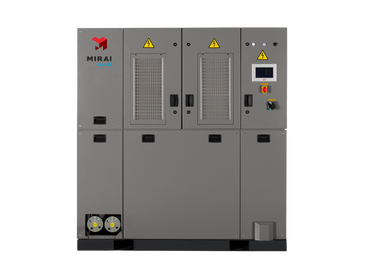
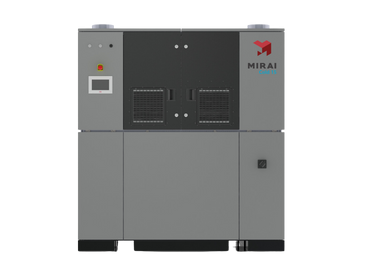
Low Operating Costs of Refrigeration Equipment: How MIRAI Space Cooler Reduces TCO

When choosing refrigeration equipment for very low temperatures, you should think about more than just the cost of installation. You should also think about the total cost of running it over its entire service life.
The MIRAI Space Cooler system was made with the goal of keeping operating costs low, getting the most energy out of each unit, and making sure that the Total Cost of Ownership (TCO) is easy to predict.
Why Traditional Refrigeration Systems Are Expensive to Operate
In standard vapor-compression systems, the costs of running them are high because they are complicated and have a lot of parts that need to be serviced.
Using synthetic refrigerants means you have to keep paying for refills and leak control. The oil system needs to be maintained all the time, consumables need to be replaced, and the condition needs to be checked.
Frost forming on heat exchangers and the need for regular defrost cycles also raise operating costs because they use more energy and stop the system from working.
All of these things make these systems costly to run and less reliable.
|
Parameter |
MIRAI Air Cycle |
Vapor Compression System |
|
Refrigerant |
Atmospheric air |
Synthetic refrigerant |
|
Refrigerant refilling |
Not required |
Required |
|
Oil system |
None |
Required |
|
Oil replacement |
Not required |
Regular |
|
Evaporators in the chamber |
None |
Required |
|
Heat exchanger icing |
None |
Inevitable |
|
Defrost procedures |
Not required |
Regular |
|
Number of serviced components |
Minimal |
Significant (all of the above) |
Air Cycle Refrigeration as the Basis of MIRAI Efficiency
The MIRAI Space Cooler system uses Air Cycle Refrigeration, which uses atmospheric air (R729) as the working medium.
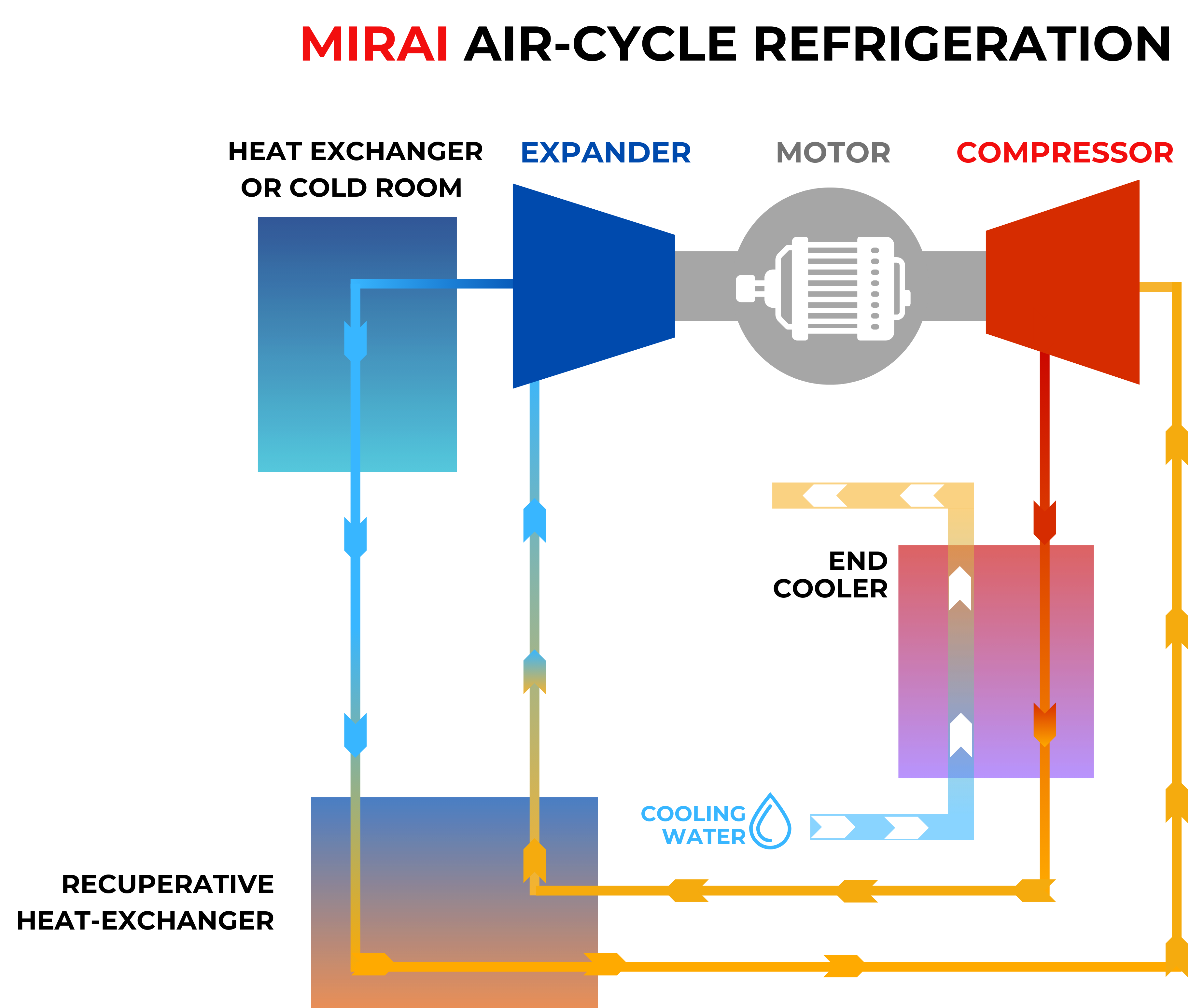
This changes the way the business works in a big way. You don't have to buy air, it doesn't leak, and you don't have to throw it away. Unlike traditional solutions, all costs associated with refrigerants and their maintenance are completely eliminated.
This method not only makes the system better for the environment, but it also saves a lot of money in the long run.
Oil-Free Technology and Reduced Maintenance Costs
A turbocompressor with gas-dynamic (air foil) bearings that work on an air film is one of the most important parts of the system.
.png)
Because there is no oil system, there is no need to change the oil, filter it, or check its condition. This gets rid of a lot of the normal operating costs that come with regular compressor systems.
These bearings are also made to last the full life of the equipment, which can be up to 20 years. This means that the equipment will run smoothly and reliably without additional intervention.
Simplified Design as a Reliability Factor
Compared to vapor-compression units, the MIRAI system has a much simpler design.
It doesn't have any of the parts that make up a normal refrigeration circuit, like evaporators, condensers, expansion valves, or other parts. This cuts down on the number of places where things could go wrong and makes maintenance less necessary.
Because of this, the system is more reliable, and the costs of running it are lower and easier to predict.
No Frost Formation and Defrost Costs
One of the key advantages of MIRAI technology is the absence of frost formation inside the chamber.
This is possible thanks to the Snow Catcher (Humidity Extraction Device, HED), which takes moisture out of the air stream before it can settle on cold surfaces.
.png)
In traditional systems, frost always forms, which means that the system needs to be defrosted regularly. This uses more energy and causes downtime. In MIRAI, these processes are completely eliminated, further reducing operating costs.
Comparison of MIRAI and Conventional Refrigeration Systems
It's easy to see how the two approaches work differently when you compare them.
The MIRAI system uses air from the atmosphere instead of synthetic refrigerants. It doesn't have an oil system, so you don't have to refill the refrigerant, and there are no frost formation or defrosting processes.
In traditional systems, all of these parts are there and need to be maintained on a regular basis, which greatly raises the cost of running the system.
Total Cost of Ownership (TCO) as a Key Performance Indicator
When looking at refrigeration equipment, it's important to think about the Total Cost of Ownership, which includes not just the purchase price but also all the costs over the equipment's lifetime.
Industrial refrigeration equipment usually lasts between 15 and 20 years, and during that time, the cost of running it can be much higher than the cost of buying it.
In traditional systems, compressor maintenance, oil system servicing, refrigerant management, evaporator operation, and energy use for defrost cycles make up a large part of the total cost of ownership (TCO).
How MIRAI Reduces Total Costs
Most of these costs are cut out in MIRAI systems due to design features..
Using air as the working medium means that you don't need refrigerants. Not having an oil system makes maintenance cheaper. The simpler design means fewer service operations. Getting rid of frost gets rid of the energy used to defrost.
Because of this, the system runs smoothly, needs little maintenance, and has predictable operating costs.
Where MIRAI Technology Delivers Maximum Value
The MIRAI system is most effective in ultra-low temperature applications in the range of −40 to −130 °C.
This is particularly relevant for the pharmaceutical industry, cryogenic storage, scientific laboratories, and climate testing, where temperature stability, reliability, and cost control are critical.
Conclusion: Cost Efficiency Without Compromise
The MIRAI Space Cooler system has a lower total cost of ownership over its entire life than standard refrigeration systems because it is more energy-efficient, more reliable, and costs less to run. This benefit is especially clear in applications that need very low temperatures, where maintenance is usually high.
MIRAI technology guarantees stable performance and lower operating costs by getting rid of refrigerants, oil systems, and defrost cycles, and making the design simpler. Because of this, it is the best choice for situations where long-term cost-effectiveness and predictability are important, such as in the pharmaceutical industry, cryogenic storage, scientific labs, and climate testing.