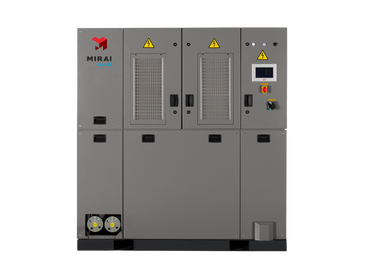
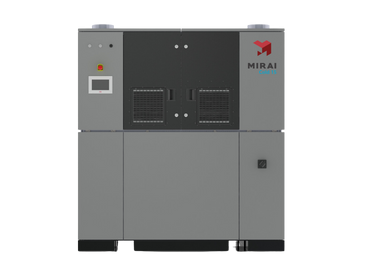
How Absence of Icing in MIRAI Systems Improves Cooling Energy Efficiency

One of the best things about the MIRAI Space Cooler system is that there is no ice forming in the cooled chamber. This feature is very important for ultra-low temperature applications, where frost buildup can quickly make regular refrigeration equipment work less well.
In standard vapor-compression refrigeration systems, the chamber's inside has heat-exchange surfaces (evaporator coils) that cool the air. When humid air comes into contact with these cold surfaces, several processes occur:
- moisture condensation
- frost formation
- gradual accumulation of an ice layer
Over time, this ice layer significantly reduces heat transfer efficiency.
The MIRAI system fixes this problem in a very different way. A special device is used to remove moisture mechanically:
.png)
Pic. 1. How does ULT Space Cooler work
Snow Catcher
This module captures and removes moisture particles and ice crystals from the air stream before they can settle on cold surfaces.
This is particularly important when operating within the temperature range from −40 °C to −130 °C, while the most typical operating temperatures are from −70 °C to −90 °C.
It is precisely within this range that frost formation becomes one of the main limitations of conventional refrigeration systems.
.png)
Pic. 2. MIRAI INTEX ULT Space Cooler with Snow Catcher installed in the chamber
.png)
Pic. 3. Snow Catcher demonstration
Heat Transfer and the Effect of Frost
From a heat transfer perspective, frost formation leads to an increase in thermal resistance between the cooled surface and the air.
The total thermal resistance can be expressed as:
.png)
hair - convective heat transfer coefficient on the air side
hair = 10-100 W/m2K
δ — layer thickness
k — thermal conductivity of the material
Accordingly, the heat transfer coefficient is:

Consider a simple heat exchanger with a wall thickness of 1 mm. The thermal conductivity of stainless steel is approximately 16 W/(m·K). Accordingly, the thermal resistances of the wall and the air side are:


Therefore, for a clean surface, the total thermal resistance will be:

Accordingly, the heat transfer coefficient for a clean surface will be:

Effect of a Frost Layer
The thermal conductivity of ice is approximately 2.2 W/(m·K) at 0 °C and can increase to about 3.5 W/(m·K) at −100 °C.
However, due to its porous structure, the effective thermal conductivity of frost is significantly lower. As a result, the presence of frost leads to a rapid increase in the thermal resistance of the heat-exchange surface. For this reason, it is important to consider the influence of frost on heat transfer.
According to NASA research, the thermal conductivity of frost depends strongly on its density. For a typical frost density of about 300 kg/m³, the effective thermal conductivity is approximately:
kfrost=0.126 W/mK
δfrost=1 mm
Therefore, for the surface, the thermal resistance will be:

Total system resistance:


Relative reduction in efficiency:

Thus, even a frost layer with a thickness of only 1 mm can reduce heat transfer efficiency by approximately 19%.
Now consider the situation when the frost thickness increases.
If the frost layer reaches 3 mm, then the thermal resistance becomes:


And the heat transfer coefficient will be:


This means that a frost layer of about 3 mm reduces heat transfer efficiency by more than 40%.
Why MIRAI Technology Is More Energy Efficient
In traditional refrigeration systems, frost accumulation is one of the main factors that reduces operational efficiency over time. As air moisture freezes on cold heat-exchange surfaces, the growing frost layer acts as an insulating barrier that interferes with heat transfer.
This leads to several negative effects:
- deterioration of heat transfer
- increased energy consumption
- reduced cooling capacity
- the need for regular defrost cycles
As the frost layer thickens, the refrigeration system must work harder to maintain the desired temperature. Fans and compressors work harder, which uses more electricity and speeds up the wear and tear on system parts.
To keep working well, traditional systems start defrost cycles from time to time to get rid of ice that has built up. But these cycles make things much less efficient.
Every time you defrost, the cooling stops, the system uses more energy to melt the ice, the temperature within the chamber becomes unstable, and the system is less available for a short time.
These disruptions can be especially bad for applications that need to run at ultra-low temperatures all the time.
The Snow Catcher system keeps frost from forming by taking moisture out of the air before it can settle on cooling surfaces. The system keeps the heat-exchange surfaces clean while it works by getting rid of the cause of frost development.
This method makes sure that:
- the heat transfer conditions stay the same over time
- there are no defrost cycles
- continuous system operation
- the heat exchanger's thermal efficiency goes up
- and the overall energy efficiency goes up.
Because of this, the MIRAI system can keep its cooling performance steady while using less energy and having fewer operating interruptions. This is mainly useful for ultra-low-temperature applications and long-term cooling procedures.
.png)
Pic. 4. comprassion Other systems vs MIRAI systems
Where This Is Especially Important
The benefits of MIRAI technology are mainly important in situations where very low temperatures need to be kept stable and reliable. In many advanced industrial and scientific settings, even small changes in temperature or interruptions in cooling can cause materials to break down, experiments to go wrong, or equipment to break.
Some common uses are:
- storing biological and pharmaceutical materials
- testing the climate and environment
- ultra-low-temperature technological processes
- scientific and laboratory research.
When storing biological samples, vaccines, enzymes, and genetic materials in biotechnology and pharmaceuticals, the temperature needs to stay between −70 °C and −90 °C. Any temperature fluctuations during defrost cycles or loss of efficiency due to frost buildup can damage the samples and make storage less reliable.
In climatic testing chambers, parts and materials are put in controlled temperature environments to see how they act in extreme conditions. To get accurate and repeatable test results, cooling performance needs to be stable and predictable.
In industrial ultra-low-temperature processes, cooling systems may run for long periods of time without stopping. Energy efficiency and continuous operation are essential, as frequent defrost cycles elevate operational expenses and compromise process stability.
In the same way, scientific research labs may need to keep their thermal environments very stable for long periods of time for experiments. Frost buildup on cooling surfaces can change the temperature, make heat transfer less efficient, and cause the experiment to go off course from what was planned.
The most important things in all of these applications are:
- temperature stability
- equipment reliability
- continuous operation
- minimal energy consumption
To make it clear how frost affects the energy efficiency of a cooling system, you can look at how the thickness of the frost layer affects the heat transfer coefficient. The graph below shows that even a small rise in frost thickness makes heat exchange less efficient.
As frost builds up, the system's energy use goes up, the heat transfer coefficient goes down, and the thermal resistance goes up.
This is why stopping frost from forming is one of the most important things to do to make refrigeration systems use less energy.
.png)
Graph 1. Effect of Frost Layer Thickness on Heat Transfer Efficiency
A thin layer of frost can significantly increase the thermal resistance between the air and the cooling surface. The efficiency drops by about 19% at a thickness of 1 mm and by more than 40% at a thickness of 3 mm.
In MIRAI systems, frost formation is prevented by the Snow Catcher, which allows the system to maintain stable heat transfer and high energy efficiency.
References
- “Thermal Properties of Ice.” Engineering ToolBox.
https://www.engineeringtoolbox.com/ice-thermal-properties-d_576.html - Processes, Vol. 9, Issue 3, Article 412. MDPI.
https://www.mdpi.com/2227-9717/9/3/412 - NASA Technical Report: Frost Properties and Modeling. NASA Technical Reports Server (NTRS).
https://ntrs.nasa.gov/api/citations/20110001592/downloads/20110001592.pdf