Ultra-Low Temperature Freezer Temperature Range Explained

Ultra-low temperature (ULT) storage is critical for biotech, pharma, and clinical operations, but the conversation is shifting. It’s no longer just about hitting −80°C—it’s about energy cost, system reliability, and lifecycle economics.
Traditional ultra-low temperature freezers operate between −40°C and −90°C, with −80°C as the standard. However, rising electricity costs, regulatory pressure on refrigerants, and maintenance complexity are forcing operators to rethink system selection.
Today, decisions around ultra-low freezers increasingly focus on:
- Energy consumption (OPEX impact)
- System downtime risk
- Maintenance burden
- Regulatory compliance costs
A ULT freezer is a refrigeration system designed to maintain temperatures between −40°C and −90°C, enabling long-term storage of sensitive materials such as vaccines, DNA, and biological samples.
These systems are widely used in:
- Biobanks
- Pharmaceutical manufacturing
- Clinical labs
Typical Temperature Use Cases
|
−40°C |
Short-term storage |
Low energy |
Lower system stress |
|
−60°C |
Pharma storage |
Moderate |
Transitional range |
|
−80°C |
Standard research |
High |
Industry standard |
|
−86°C to −90°C |
Long-term biobank |
Very high |
Diminishing returns |
What Is an Ultra-Low Temperature (ULT) Freezer?
A ULT freezer is a refrigeration system designed to maintain temperatures between −40°C and −90°C, enabling long-term storage of sensitive materials such as vaccines, DNA, and biological samples.
These systems are widely used in:
- Biobanks
- Pharmaceutical manufacturing
- Clinical labs
Typical Temperature Range of ULT Freezers
Ultra-low freezers generally operate in the −40°C to −90°C temperature range. The most common set point is −80°C, which balances preservation efficacy with energy efficiency. Here’s a comparison of typical ranges and applications: Temperature Range: Typical Application -40 °C to −60°C Short-term sample storage, enzymes −80°C Long-term DNA, RNA, vaccines −86°C to −90°C Advanced research, rare samples.
The −80°C freezer remains the gold standard because it is effective for most biological materials.
The temperature range of ultra-low freezers varies depending on the application. Most laboratory systems operate between −40 °C and −90 °C, but −80 °C remains the most common operating point.
Typical Temperature Use Cases:
|
Temperature Range |
Primary Use Case |
Cost Impact |
Operational Notes |
|---|---|---|---|
|
−40°C |
Short-term storage |
Low energy |
Lower system stress |
|
−60°C |
Pharma storage |
Moderate |
Transitional range |
|
−80°C |
Standard research |
High |
Industry standard |
|
−86°C to −90°C |
Long-term biobank |
Very high |
Diminishing returns |
These extremely low temperatures dramatically slow biochemical reactions, helping preserve biological materials for months or years.
Why −80°C Is the Industry Standard
The dominance of −80 °C is not arbitrary but reflects decades of scientific validation and operational experience. At this temperature:
- Enzymatic activity is nearly halted
- Molecular degradation is significantly slowed
- Ice crystal formation is minimized
- Biological samples remain stable for long durations
Importantly, achieving temperatures lower than −80 °C introduces diminishing returns in preservation quality while dramatically increasing system complexity, energy consumption, and maintenance requirements.
Thus, −80 °C represents a practical equilibrium between performance, cost, and reliability.
What Is the Coldest Temperature a ULT Freezer Can Reach?
The technical lower limit for most ULT freezers is around −90°C. This is determined by the physical properties of refrigerants and the efficiency of cascade refrigeration systems. Below −90°C, conventional units become prohibitively complex and unreliable, with sharply rising energy costs and maintenance requirements. For ultra-low temperature applications beyond this, cryogenic solutions such as liquid nitrogen are needed.
How Does an Ultra-Low Temperature Freezer Work?
Ultra-low temperature freezers rely on cascade refrigeration, a two-stage cooling process. The primary stage uses a conventional refrigerant to cool down to about −40°C. The secondary stage, with a different refrigerant, further cools the chamber down to the ultra-low freezer temperature range of −80°C or −90°C. This architecture enables ultra-low temperature operation while managing compressor loads and efficiency. (A process diagram could illustrate the two refrigeration stages, showing heat flow and refrigerant transitions.)
Most traditional ultra-low-temperature freezers use cascade refrigeration systems. These systems combine two refrigeration cycles to reduce the temperature inside the freezer chamber gradually.
Typical cascade process:
- First compressor cools the chamber to about −40 °C
- The second refrigeration stage reduces the temperature further to −80 °C.
- Sensors regulate the internal temperature.
- Heat is expelled through a condenser.
This approach allows conventional refrigeration systems to reach extremely low temperatures while maintaining stability.
Cascade Refrigeration Systems
Most ultra-low freezers use cascade refrigeration, combining two cooling cycles to reach ultra-low temperatures.
Key issue: while effective, this design drives higher energy use and maintenance costs.
Operational drawbacks:
- High energy consumption (8–20 kWh/day)
- Multiple failure points (compressors, refrigerants)
- Increased service requirements
Limitations of Cascade Refrigeration
While cascade systems have been the industry standard for decades, they come with several drawbacks:
High Energy Consumption
ULT freezers are among the most energy-intensive laboratory devices, consuming between 8 and 20 kWh per day per unit. Facilities with multiple freezers face high operational costs.
Mechanical Complexity
The use of multiple compressors, refrigerants, and heat exchangers increases the risk of component failure and maintenance requirements.
Refrigerant Dependency
Cascade systems rely on high-global-warming-potential (GWP) refrigerants, which are increasingly restricted under environmental regulations.
Maintenance Burden
Regular service is required to ensure system reliability, including monitoring refrigerant levels, compressors, and insulation performance.
Insulation and Heat Leakage Control
Maintaining ultra-low temperatures is not just about cooling—it’s about minimizing heat gain.
Poor insulation leads to:
- Increased energy consumption
- Temperature instability
- Higher compressor workload
The Role of Insulation and Thermal Management
Maintaining ultra-low temperatures is not only about cooling, but also equally about minimizing heat gain.
Key insulation technologies include:
- Vacuum insulation panels (VIPs)
- High-density polyurethane foam
- Multi-layer door sealing systems
Even small amounts of heat leakage can significantly increase energy consumption and destabilize internal temperatures. Therefore, proper insulation design and maintenance are critical for efficient ULT operation.
Energy Consumption of −80°C Freezers
Energy use for −80°C freezers typically ranges from 8 to 20 kWh per day, depending on ambient conditions, door-opening frequency, compressor efficiency, and freezer age. Energy efficiency is a growing concern due to rising operational costs and sustainability goals, especially for facilities with multiple ultra-low-temperature freezers or cold-storage logistics operations.
Energy Challenges in ULT Storage
Energy consumption has become one of the most pressing issues in ULT storage. As laboratories scale up operations and sustainability targets become more stringent, the inefficiency of traditional systems becomes increasingly problematic.
Key factors influencing energy use include:
- Ambient temperature
- Frequency of door openings
- Age and condition of the freezer
- Compressor efficiency
- Insulation quality
In large facilities, ULT freezers can account for a substantial portion of total energy consumption, making efficiency improvements a top priority.
Operational Risks and Limitations of ULT Freezers
Risks include refrigerant leaks, compressor wear, temperature excursions (from defrost cycles or power failures), and the maintenance burden of complex cascade systems. There’s also increasing regulatory pressure on high-global-warming-potential (GWP) refrigerants, which can add to compliance costs and operational risks.
Regulatory and Environmental Constraints
Environmental regulations, such as the EU F-Gas rules, are phasing out many traditional refrigerants due to their GWP. ULT freezer operators face long-term compliance risks and may need to retrofit or replace units as rules tighten. Sustainability pressure is driving the adoption of alternative cooling methods and refrigerant-free systems.
Global environmental regulations are reshaping the refrigeration industry. In particular, the European Union’s F-Gas regulations aim to phase down the use of high-GWP refrigerants.
This has several implications:
- Increased compliance costs
- Need for system redesign or replacement
- Accelerated adoption of alternative technologies
Organizations must now consider not only performance but also environmental impact when selecting ULT solutions.
Alternatives to Conventional ULT Freezers
Industry evolution is bringing new options for ultra-low temperature cooling. Mechanical innovations, improved refrigerants, and non-refrigerant solutions are gaining attention. These alternatives aim to reduce energy consumption, increase reliability, and comply with environmental regulations without compromising on ultra-low freezer temperature range performance.
The limitations of cascade refrigeration have driven innovation in ultra-low temperature technologies. Several emerging approaches are gaining traction:
Air-Cycle Refrigeration
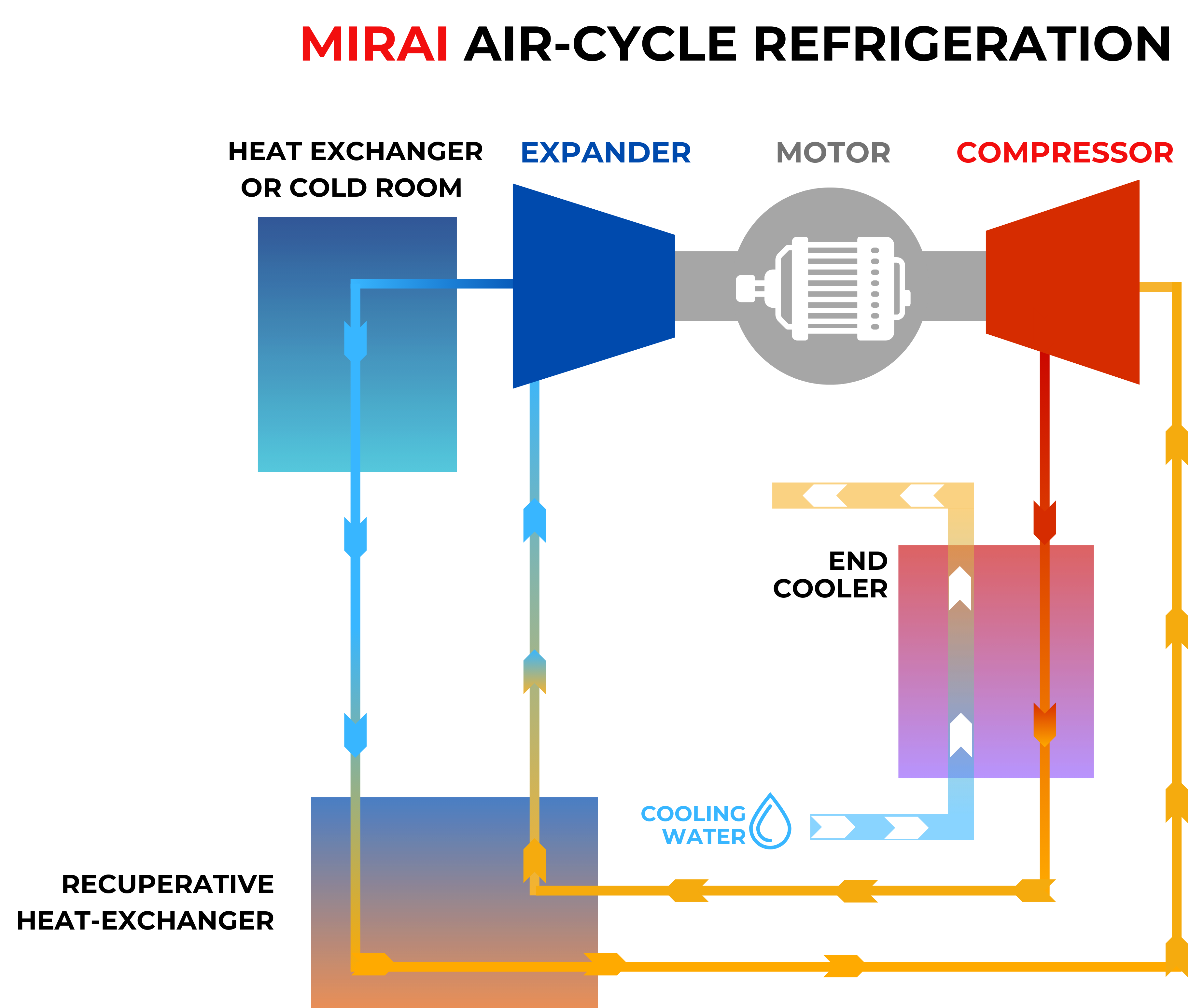
Air-cycle systems use air as the working fluid instead of refrigerants. Unlike traditional systems, they rely on compression and expansion of air rather than phase changes.
Advantages:
- No refrigerants (environmentally friendly)
- Reduced mechanical complexity
- Lower maintenance requirements
- High reliability
Stirling Cooling Systems
Stirling engines use cyclic compression and expansion of gas to achieve cooling.
Advantages:
- High efficiency
- Compact design
- Precise temperature control
Cryogenic Solutions
For temperatures below −90 °C, cryogenic systems using liquid nitrogen or CO₂ are employed.
Applications:
- Rapid freezing
- Long-term archival storage
- Specialized research processes
Air-Cycle Cooling as an Emerging Alternative
Air-cycle cooling systems use air as the working medium, eliminating the need for refrigerants and oils. They avoid phase-change refrigeration, resulting in fewer moving parts, higher reliability, and easier scalability. Air-cycle systems are rapidly gaining recognition as a sustainable, future-proof alternative for ultra-low temperature applications.
Among emerging technologies, air-cycle cooling stands out as a transformative approach. Eliminating refrigerants entirely addresses both environmental and operational challenges.
Key benefits include:
- Zero GWP impact
- Simplified system architecture
- Improved reliability
- Scalability for industrial applications
This technology is particularly well-suited for integration into advanced cold-chain infrastructure, where sustainability and uptime are critical.
Where ULT Temperature Ranges Are Not Enough
Some processes, like plasma freezing, lyophilization, or cryogenic sample preparation, require temperatures below what ultra-low freezers can achieve or need faster freezing rates. In these cases air-cycle systems used to reach lower temperatures or provide rapid cooling.
How Mirai Intex Technologies Supports Ultra-Low Temperature Applications
Mirai Intex acts as an OEM and system-level solution provider, integrating advanced cooling technologies into freeze-dryers, plasma freezers, and next-generation cold-chain infrastructure. Our solutions support the most demanding requirements for ultra-low temperature, reliability, and compliance with evolving environmental standards. Learn more about cold-chain infrastructure and cold storage logistics.
.png)
Designing Future-Ready Cold Chain Infrastructure
As global demand for temperature-controlled logistics increases, especially in pharmaceuticals and biotechnology, cold chain systems must evolve.
Future-ready infrastructure should prioritize:
- Energy efficiency
- Redundancy and reliability
- Environmental sustainability
- Scalability
- Digital monitoring and control
Advanced cooling technologies, including those developed by MIRAI INTEX, are enabling this transition.
Choosing the Right Temperature Range for Your Application
Selecting an ultra-low-temperature freezer should be based on operational impact—not just temperature capability.
Key decision factors:
- Energy Consumption
- Direct impact on OPEX
- Critical for multi-unit environments
- Lifecycle Cost
- Maintenance + downtime + energy
- Often exceeds purchase price
- System Reliability
- Risk of sample loss
- Downtime implications
- Regulatory Risk
- Phase-out of high-GWP refrigerants
- Future compliance costs
- Scalability
- Ability to support growing storage demand
Beyond temperature performance, the financial impact of ultra-low temperature storage is becoming a primary decision driver. Operators must evaluate not only upfront capital expenditure, but also long-term operational costs, including energy usage, maintenance, downtime risk, and regulatory compliance. In many cases, the total cost of ownership (TCO) over the system lifecycle significantly exceeds the initial purchase price.
Operational decision-making increasingly requires a holistic view of system performance. Facilities must assess how freezer selection affects energy infrastructure, redundancy planning, service intervals, and risk management strategies. As a result, procurement decisions are shifting from purely technical specifications toward integrated cost-performance optimization, ensuring that ultra-low temperature solutions align with both budget constraints and operational reliability goals.
Future Trends in ULT Cooling
The future of ultra-low temperature storage is being shaped by several key trends:
- Transition to refrigerant-free technologies
- Integration of smart monitoring systems
- Increased focus on sustainability
- Modular and scalable system designs
- Greater emphasis on lifecycle cost optimization
As these trends converge, the definition of a “best-in-class” ULT system is expanding beyond temperature alone.
Conclusion
Ultra-low temperature storage is no longer just a technical requirement—it’s a cost and risk management decision.
While traditional cascade-based ultra-low freezers remain common, their energy intensity, maintenance burden, and regulatory exposure are driving a shift toward alternative technologies.
Organizations that prioritize efficiency, reliability, and lifecycle cost will be better positioned to scale operations and control long-term expenses.

