Reliability of MIRAI Space Cooler

Introduction
Reliability is one of the key criteria when selecting industrial refrigeration equipment, especially for ultra-low-temperature applications. A refrigeration system failure can lead not only to a shutdown of the production process, but also to the loss of expensive products, disruption of technological cycles, and significant financial losses.
Traditional low-temperature refrigeration systems based on the vapor-compression cycle contain a large number of components and auxiliary systems required to ensure refrigerant circulation, oil return, phase transition control, and prevention of heat exchanger icing. Each additional subsystem increases the complexity of the equipment and the number of potential failure points.
MIRAI Space Cooler units use a different approach. Their operation is based on an open air cycle, using atmospheric air as the only working medium. The elimination of liquid refrigerants, oils, and a number of auxiliary systems makes it possible to significantly simplify the design of the refrigeration machine and increase its operational reliability.
Operating Principle of MIRAI Space Cooler
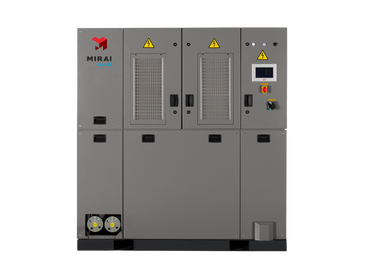
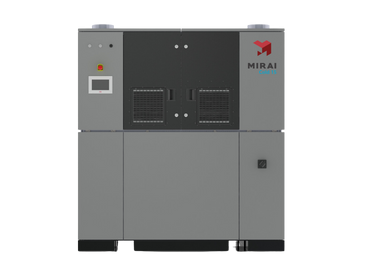
Air from the cooled chamber enters the refrigeration unit and passes through the Snow Catcher moisture removal system. After that, the flow is compressed in the turbocompressor, passes through intercooling and the recuperator, and then expands in the expander. As a result of expansion, the air temperature drops significantly, after which the cooled air returns back to the chamber.
Unlike vapor-compression refrigeration systems, the working medium remains in a gaseous state throughout the entire cycle. The unit does not involve boiling, condensation, or circulation of liquid refrigerant.
This distinction is one of the key factors behind the high reliability of the system.
.png)
Simplicity of Design as the Basis for Reliability
In engineering practice, there is a simple rule: the fewer components involved in the process, the lower the probability of equipment failure.
Traditional low-temperature refrigeration systems usually include:
• Several compressors
• Condensers
• Evaporators
• Expansion valves
• Oil separators
• Receivers
• Filter driers
• Oil return system
• Defrost system
• A large number of pipelines and connections
Each of these elements requires maintenance and can become the cause of unplanned equipment downtime.
The MIRAI design is significantly simpler. The main elements of the refrigeration unit are:
• Turbocompressor unit
• Recuperator
• Intercooling system
• Snow Catcher
• Air filters
Reducing the number of components automatically reduces the number of potential failure mechanisms.
System reliability is achieved not by adding redundancy to a large amount of equipment, but by eliminating the causes of possible failures themselves.
Absence of Refrigerant
One of the most common reasons for servicing traditional refrigeration systems is issues related to refrigerant.
These include:
• Refrigerant leaks
• Reduced refrigerant charge
• Contamination of the refrigeration circuit
• Moisture ingress into the system
• Need for recharging
• Leak detection
• System tightness control
Even a minor leak can lead to reduced unit performance and deterioration of operating characteristics.
In the MIRAI system, these problems are absent by definition. Atmospheric air is used as the working medium, and it does not require charging, quantity control, or maintenance.
Thus, an entire class of failures associated with refrigerant operation is completely eliminated.
Absence of Oil
Another typical feature of traditional refrigeration systems is the need to use oil for compressor lubrication.
During operation, the following potential problems may occur:
• Oil degradation
• Oil contamination
• Oil return failure
• Formation of oil deposits
• Need for periodic oil replacement
• Maintenance of oil separators
These mechanisms are absent in MIRAI.
The turbomachine uses gas-dynamic bearings operating on an air film. Under normal operating conditions, there is no mechanical contact between rotating elements, which makes it possible to eliminate the use of lubricants.
.png)
The absence of oil not only simplifies the equipment design, but also eliminates the need for a number of service operations throughout the entire service life.
Gas-Dynamic Bearings and Turbomachine Service Life
One of the key elements of the MIRAI refrigeration unit is the high-speed turbocompressor unit.
The rotor speed reaches 85,000 rpm.
Gas-dynamic bearings are used to ensure reliable operation. In these bearings, the rotor is supported by an air film formed during rotation.
This solution provides a number of advantages:
• No mechanical contact between working surfaces
• No bearing wear under normal operating conditions
• No lubricants
• No lubrication system
• Reduced maintenance requirements
As a result, a long equipment service life and stable performance characteristics are achieved throughout the entire operating period.
The design service life of the unit is up to 20 years.
Moisture Removal Without a Defrost System
One of the main problems of traditional low-temperature refrigeration systems is ice formation on the surface of evaporators.
As ice accumulates, the following occurs:
• Heat exchange deteriorates
• Aerodynamic resistance increases
• Fan energy consumption rises
• Cooling capacity decreases
• Defrost cycles become necessary
Additional defrost systems are used to combat icing, increasing equipment complexity and requiring additional energy consumption.
MIRAI uses a fundamentally different approach.
After the air is cooled, the moisture it contains turns into fine ice particles. These particles are captured by the filters of the Snow Catcher system.
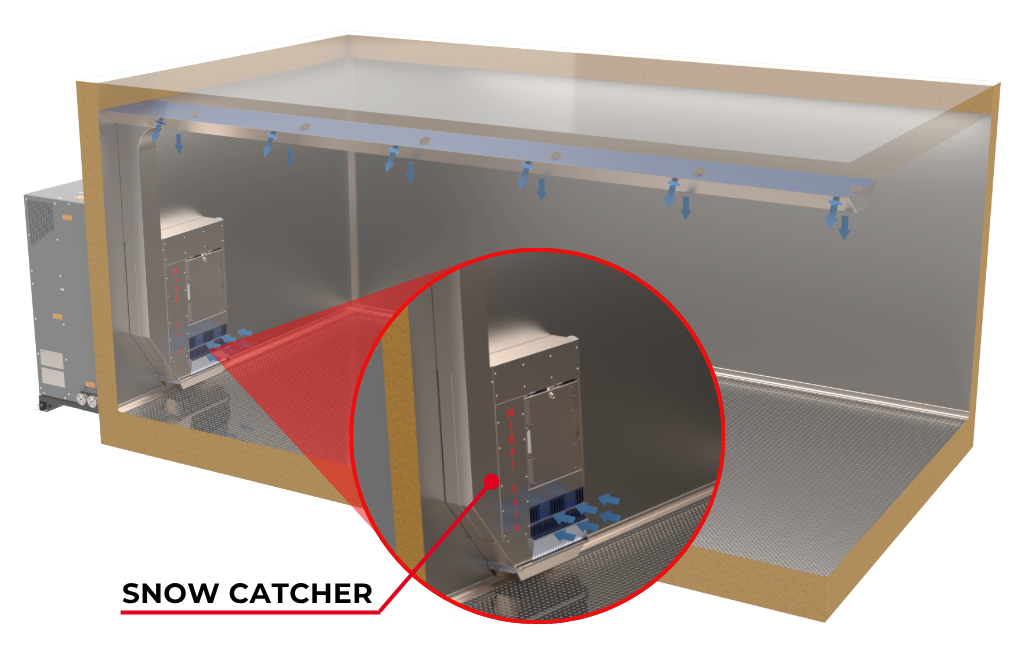
As ice accumulates, automatic filter cleaning is performed. A pressurized air flow removes the accumulated ice particles from the filter surfaces. The ice is then collected in a special collection tray or removed by a transport system.
As a result, there is no need for a traditional defrost system, and the cooling capacity remains stable over a long period of operation.
Cleanliness of the Refrigeration System
The working medium in MIRAI is atmospheric air.
The refrigeration circuit contains no:
• Oils
• Liquid refrigerants
• Oil decomposition products
• Oil and refrigerant mixtures
This ensures a high level of cleanliness inside the unit’s internal circuit.
This is especially important for the pharmaceutical industry, research laboratories, the aerospace sector, and other areas where high requirements are placed on equipment cleanliness and process stability.
Minimum Maintenance Requirements
The number of elements requiring periodic maintenance is reduced to a minimum.
The serviceable components include:
• Air filter
• Filtering elements of the Snow Catcher system
At the same time, there is no need for:
• Oil replacement
• Oil quality control
• Refrigerant recharging
• Maintenance of oil separators
• Maintenance of the defrost system
• Replacement of expansion valves
Reducing the amount of service work has a positive effect on both operating costs and overall equipment availability.
Practical Confirmation of Reliability
The MIRAI open air cycle concept is not an experimental technology.
Today, hundreds of MIRAI units of various capacities and applications are operating worldwide.
Many years of operating experience confirm the effectiveness of the selected technical solutions and demonstrate a high level of equipment reliability under real operating conditions.
Practical application experience is important confirmation that high reliability is achieved not only theoretically, but is also proven by many years of equipment operation at customer sites.
Conclusion
The high reliability of MIRAI Space Cooler refrigeration units is achieved through a fundamentally different refrigeration cycle architecture.
The use of atmospheric air as the only working medium makes it possible to eliminate liquid refrigerants, oils, expansion valves, defrost systems, and other elements that are traditionally sources of refrigeration equipment failures.
The use of gas-dynamic bearings, the minimum number of serviceable components, and the absence of complex auxiliary systems reduce the probability of failures and ensure a long service life of the equipment.
Thus, MIRAI reliability is achieved not by making the design more complex and introducing additional redundant systems, but by eliminating the mechanisms that cause failures. This approach makes MIRAI Space Cooler an efficient and reliable solution for ultra-low-temperature cooling.