Stable Cooling Performance by Eliminating Chamber-Internal Degradation Mechanisms Introduction

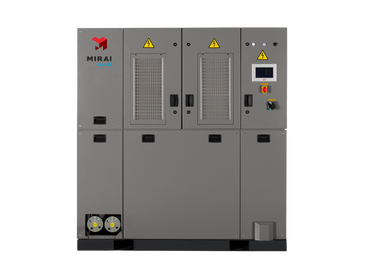
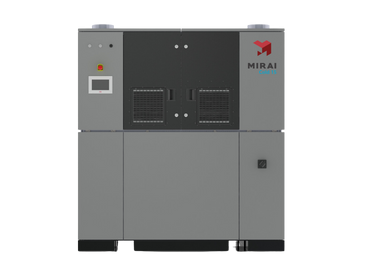
MIRAI units operate in an open-air cycle and supply cooled air directly into the chamber. Therefore, inside the chamber there are not:
- evaporators coils;
- evaporator fans;
- heat exchanger mounting assemblies.
As a result, several major chamber-internal loss mechanisms typical for conventional refrigeration systems are avoided or significantly reduced. That includes reduced heat transfer due to evaporator icing, increased aerodynamic resistance across iced heat exchangers, additional fan power consumption, parasitic heat gains from internal fans, thermal inertia of metal structures inside the chamber and energy losses associated with defrost cycles.
The following sections compare the main loss mechanisms of conventional systems and show why the MIRAI architecture can avoid or significantly reduce these effects.
Reduction of Heat Transfer Capacity Due to Heat Exchanger Icing of evaporator systems
The cooling capacity transferred through a heat exchanger can be estimated using the standard heat-transfer relation:

where:
Q = heat transfer rate / cooling capacity, W
U = overall heat transfer coefficient, W/m²K
A = effective heat transfer surface area, m²
ΔT = temperature difference between air and refrigerant/heat-transfer medium, K
For a clean heat exchanger, assume:

When icing occurs, frost partially blocks the free flow area of the heat exchanger. This increases the resistance coefficient and therefore increases the pressure drop at a given air velocity.

That is, the losses amount to 40%, and if the system is required to deliver, for example, 10 kW of cooling, the heat exchanger will effectively be able to transfer only 6 kW:

Conclusion: In conventional evaporator-based systems, frost formation on the heat exchanger can significantly reduce the effective heat-transfer capacity. Depending on the degree of icing, airflow reduction and system control strategy, the transferable cooling capacity may decrease by approximately 30–50%, or the system may require longer operating times and lower efficiency to maintain the target chamber temperature.
Increase in Aerodynamic Resistance Due to Heat Exchanger Icing
The pressure drop across a heat exchanger can be estimated using the following relation:

where:
.png)
When icing occurs, the free flow area decreases and the resistance coefficient increases.
Assume an air velocity of v =3 m/s, and an air density at -80°С of ρ =1.83 kg/m3:
| Heat exchanger | Resistance coefficient | Pressure drop |
|
Clean heat exchanger |
10 |
~80 Pa |
|
Partially iced |
25 |
~200 Pa |
|
Severely iced |
50 |
~400 Pa |
Fan power:

Assume the airflow rate:

Fan efficiency under real operating conditions is typically in the range of 0.5–0.7, depending on the fan type and operating point. A value of 0.6 is assumed for the calculation.
Clean heat exchanger:

Iced heat exchanger:

Increase in power consumption:

That is, due to the increase in resistance alone, a single air path may consume approximately 1.1 kW more.
In real chambers, there are typically at least two such fans, meaning the total power consumption will increase roughly twofold.

Conclusion: using a representative air path with a flow rate of 2 m³/s as an example, the calculation shows that increased aerodynamic resistance in an iced heat exchanger may raise fan power consumption to approximately 2.2 kW for two air paths. The specific value depends on the evaporator design, airflow rate, degree of icing, and the fan operating point.
Heat gain from fans inside the chamber.
If the fans are located inside the cold chamber, all of their electrical power is converted into heat:

We previously calculated the required power for an iced heat exchanger.
.png)
That is, the refrigeration system must continuously compensate for 2.2 kW of heat generated solely by the fans.
Over 24 hours:
.png)
Conclusion: fans installed inside the chamber can generate up to 53 kWh of parasitic heat load per day.
Thermal Mass of Internal Heat Exchangers and Metal Structures
Based on publicly available data, assume the heat exchanger mass to be:
.png)
As discussed earlier, we consider a chamber with two fans and two heat exchangers.
.png)
Assume the mass of the mountings to be 35% of the heat exchanger mass:
.png)
Total mass of metal structures inside the chamber:
.png)
Thermal inertia of metal structures
The energy required to cool the metal is calculated as follows:
.png)
where:

If the operating range is larger, for example from +20 °C to −80 °C
.png)
Conclusion: The thermal inertia of internal heat exchangers and support structures may require approximately 15 kWh of additional cooling energy during each pull-down cycle. This is not a continuous steady-state loss, but it increases the energy and time required to cool the chamber from ambient temperature to the operating setpoint.
Additional operational losses
In conventional systems, brackets, support frames and heat exchanger mountings may also act as thermal bridges, depending on their geometry and connection to warmer external structures. These thermal bridges can introduce additional heat into the cold chamber and increase the required refrigeration load.
It is also necessary to account for losses associated with heat exchanger defrost cycles. According to industry data, the energy consumption for defrosting in traditional refrigeration systems typically amounts to about 5–15% of the daily cooling capacity, depending on operating conditions (humidity, frequency of door openings, temperature regime).
Total estimate of parasitic losses
In a table below there are next estimations for a conventional system with two heat exchangers inside the chamber. It should be noted that these losses are not strictly cumulative, and under typical operating conditions, not all of them occur simultaneously.
|
Source of losses |
Estimate |
|
Heat transfer losses due to icing |
30–50% of actual heat transfer |
|
Increase in fan power due to resistance and heat gain |
up to 2.2 kW |
|
Heat gain from fans |
up to 2.7 kW |
|
Thermal energy of heat exchangers and mountings |
15 kWh per pull-down cycle |
|
Defrost losses |
5–15% of daily cooling capacity |
MIRAI units avoid the main chamber-internal physical causes of gradual performance degradation found in conventional evaporator-based systems: internal heat exchanger icing, increasing pressure drop across iced evaporator coils, additional fan power, parasitic heat gains from internal fans, thermal inertia of internal metal structures and recurring chamber-internal defrost cycles.
In contrast, MIRAI supplies cooled air directly into the chamber and does not rely on chamber-internal evaporator/fan assemblies. As a result, the cooling effect inside the chamber is less exposed to the degradation mechanisms typical of conventional systems. Stable long-term performance should be assessed under defined operating conditions, including chamber temperature, humidity load, air exchange, door-opening frequency and external unit maintenance condition.