Simple Chamber Integration

Less Engineering. More Cooling.
Traditional low-temperature refrigeration systems often require a significant amount of engineering work before installation can even begin. Heat exchangers must be calculated, fans selected, piping systems designed, and oil circuits, valves, sensors, and numerous auxiliary components integrated into the project. Each additional component increases system complexity, extends implementation timelines, and raises the risk of installation errors.
MIRAI Space Cooler offers a completely different approach.
Thanks to its unique air-cycle refrigeration technology, the system eliminates many of the components typically found in conventional refrigeration units. There are no evaporators inside the chamber, no refrigerant circuit, no oil systems, and no complex auxiliary equipment requiring detailed engineering and integration.
As a result, MIRAI installation becomes significantly simpler and faster. Instead of lengthy calculations and complex project documentation, the user only needs to complete a few clear installation steps before the system is ready for operation.
Let’s take a closer look at the MIRAI Space Cooler installation process step by step.
1. Equipment Unpacking
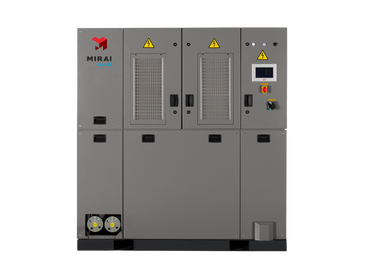
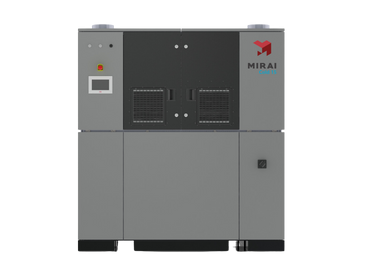
The system is delivered fully assembled and ready for installation.
Once unpacked, the unit can be positioned and prepared for commissioning without any additional assembly work. There is no need to assemble subcomponents, install internal equipment, or prepare a refrigeration circuit. This significantly simplifies the installation process and eliminates many of the potential errors commonly associated with system preparation.
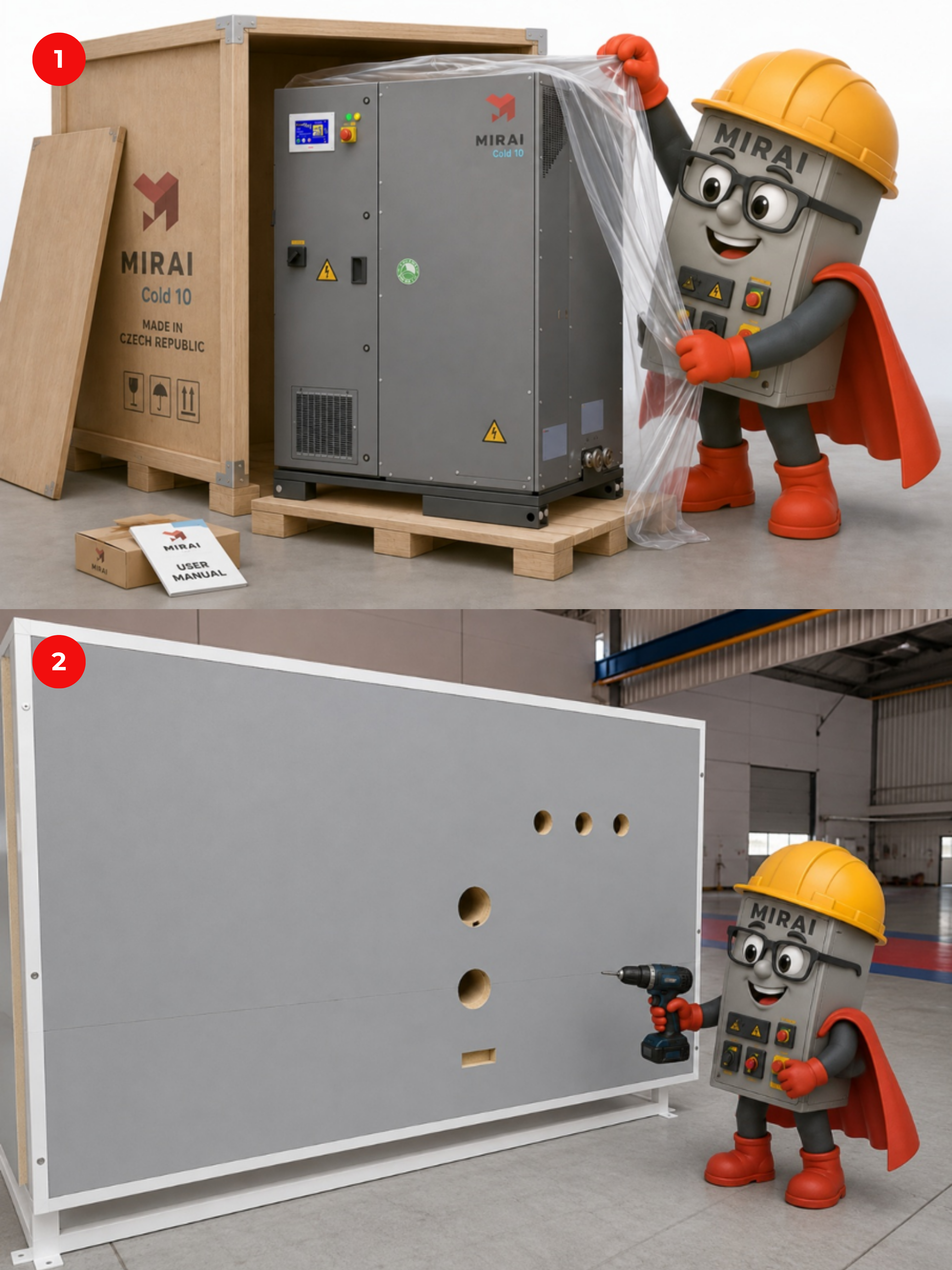
2. Chamber Preparation
Preparing the chamber for a MIRAI Space Cooler installation is reduced to creating a few service ports in the chamber wall. There is no need for complex flange connections, valves, sensors, or extensive airflow calculations, making this stage fast, straightforward, and easy to execute.
While conventional refrigeration systems often require significant engineering work and detailed planning before installation can even begin, MIRAI simplifies the process and allows users to move from chamber preparation to installation in just a few practical steps.
3. Installation of Connecting Ducts
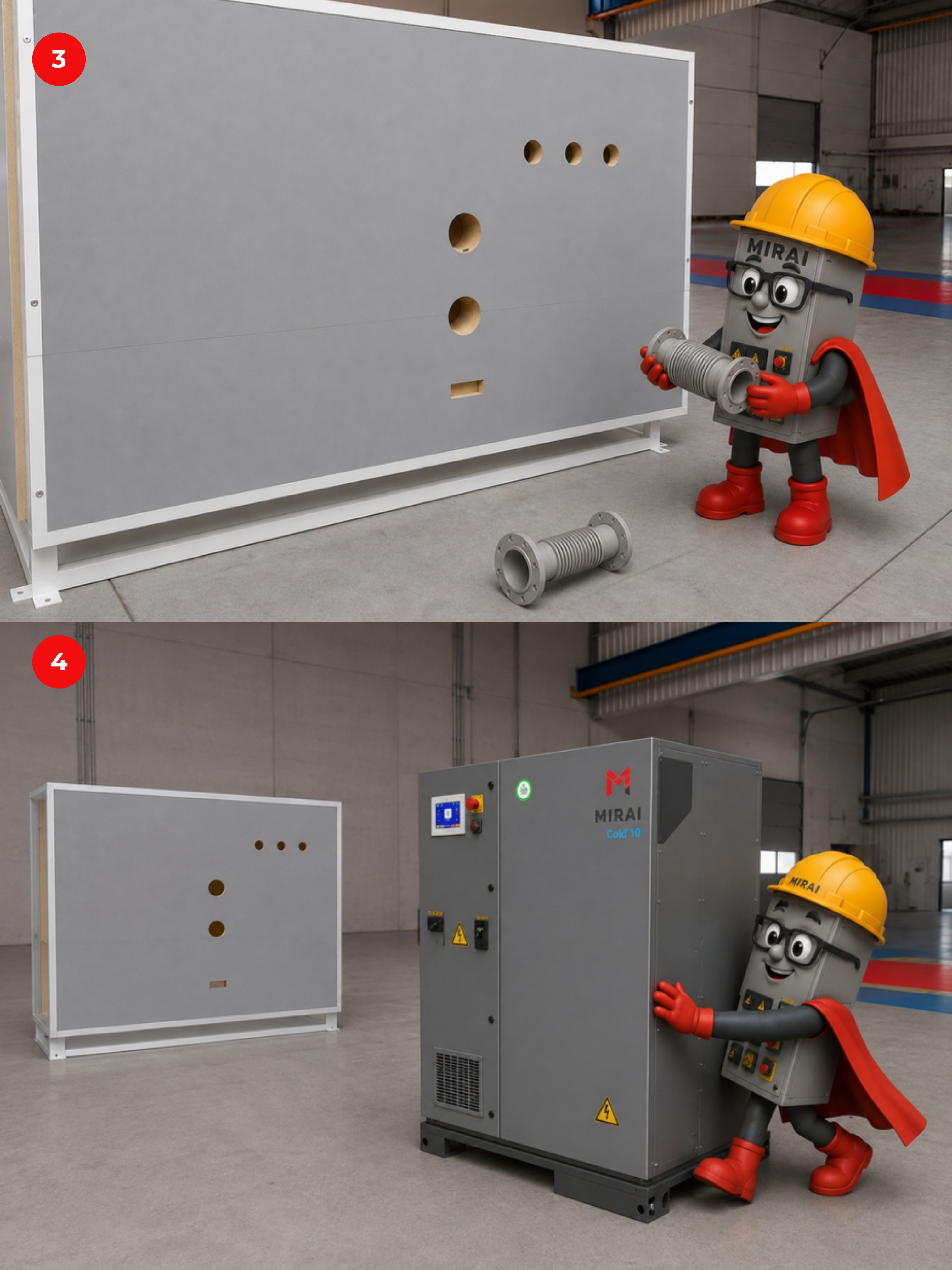
The next step is the installation of two connecting ducts between the MIRAI system and the chamber. Unlike conventional refrigeration solutions, there are no internal heat exchangers, oil lines, evaporators, or condensate drainage systems to install and maintain.
This simplified architecture, with a minimal number of connections, makes installation fast and straightforward while improving the overall reliability of the system. Fewer components mean fewer potential points of failure, reduced installation effort, and easier long-term operation.
4. Positioning the Unit next to the Chamber
Once the connecting ducts have been installed, the MIRAI unit is positioned against the chamber wall and secured in its operating location. Thanks to its compact design and streamlined architecture, installation does not require highly precise positioning, complex alignment procedures, or special vibration-isolation measures.
This significantly simplifies the installation process, reduces commissioning time, and allows the system to be brought into operation more quickly compared to conventional refrigeration solutions.
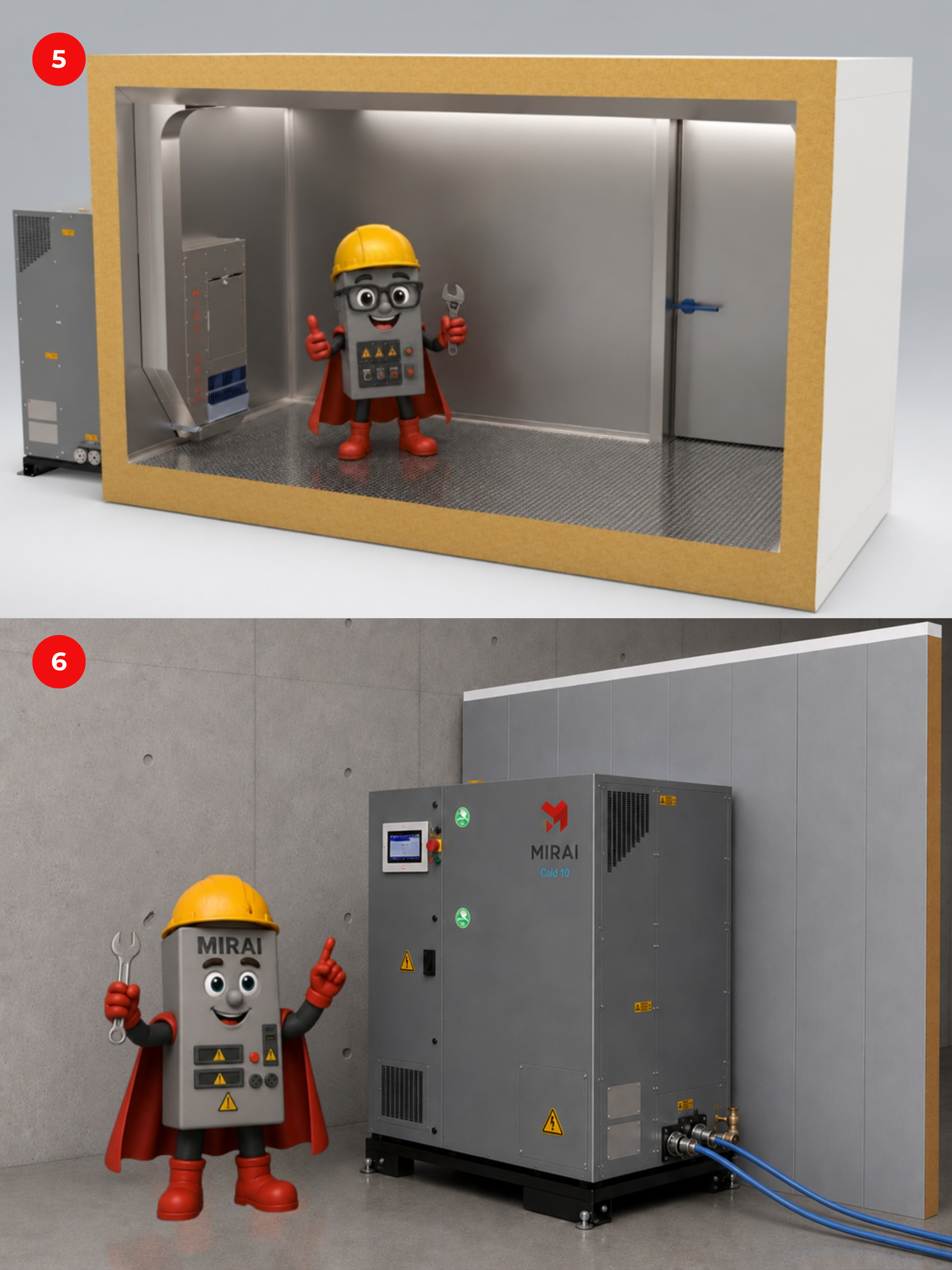
5. Installation of the Snow Catcher (HED)
The next step is the installation of the Snow Catcher (Humidity Extraction Device, HED) inside the chamber. This component is responsible for removing moisture from the circulating air.
Unlike conventional refrigeration systems, MIRAI does not use evaporators inside the chamber. As a result, there is no frost build-up, no need for defrost cycles, and no performance losses associated with ice accumulation on heat-exchange surfaces. Instead, moisture is removed mechanically by the Snow Catcher, ensuring stable cooling performance and consistent system efficiency throughout the entire operating process.
6. Cooling Water Connection
One of the final installation steps is connecting the cooling water supply required for heat rejection from the system. This is accomplished using standard supply and return water connections, without the need for complex hydraulic infrastructure.
The absence of additional refrigeration circuits, oil systems, separators, and auxiliary heat exchangers significantly simplifies system integration. As a result, installation time is reduced, commissioning becomes more straightforward, and long-term operating and maintenance costs can be kept to a minimum.
7. Final Setup and Commissioning
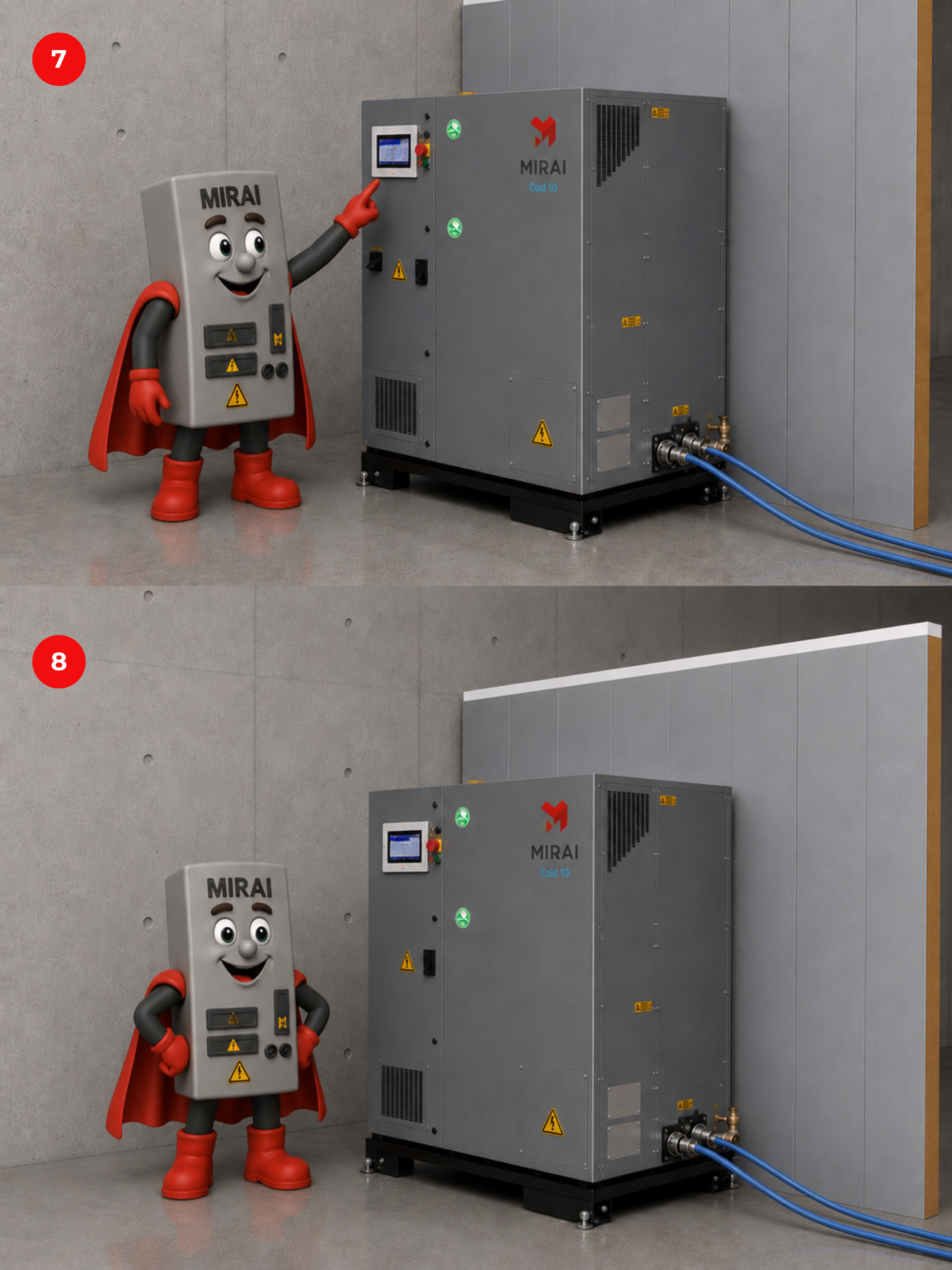
After all connections have been completed, the system is virtually ready for operation. Through the control interface, the operator simply sets the required temperature and starts the unit. From that point on, MIRAI automatically manages and stabilizes the operating conditions.
Unlike conventional refrigeration systems, there is no need to adjust the refrigeration cycle, balance airflow, or calibrate fans and evaporators. This streamlined approach significantly reduces commissioning time, minimizes installation complexity, and enables a faster transition from installation to full operation.
8. Start-Up and Operation
At this stage, the installation is complete and the system is ready for operation. Once started, the MIRAI Space Cooler automatically maintains the set temperature and ensures uniform cold-air distribution throughout the entire chamber volume.
Because there are no evaporators inside the cooled space, the system eliminates frost build-up, performance degradation, and the need for regular defrost cycles. As a result, users benefit from stable cooling performance, predictable system operation, and minimal maintenance requirements throughout the equipment’s service life.
The combination of simplified installation, reduced component count, and frost-free operation makes MIRAI Space Cooler a highly efficient and reliable alternative to conventional low-temperature refrigeration systems.
Conclusion
Installing a MIRAI Space Cooler is not a complex engineering project—it is a straightforward and structured process. While conventional refrigeration systems often require extensive design work, detailed calculations, and the integration of numerous auxiliary components, MIRAI offers a fundamentally different approach.
With a minimal number of components, no complex refrigerant circuits, and a streamlined system architecture, installation and commissioning can be completed significantly faster. The simplified design reduces project complexity, shortens implementation timelines, and allows users to move from installation to operation in just a few straightforward steps.
Simply put: connect, configure, and start cooling.