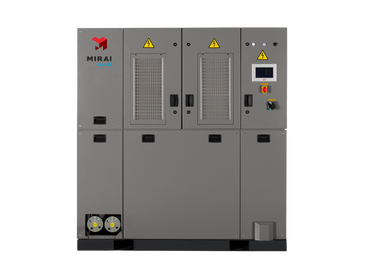
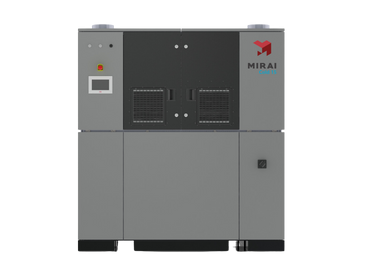
Silence is a natural part of MIRAI technology, not an extra feature.

Cooling systems based on MIRAI (R729) air cycle technology are designed from the ground up to minimize sources of noise and vibration. Unlike traditional vapor compression systems (VCS), where noise is a byproduct of multiple mechanical components, MIRAI units limit noise at the system design level.
A key factor is the absence of equipment in the cold zone. ULT Space cooler systems operate on an open cycle, delivering cooled air directly into the chamber. This eliminates the need for evaporators and fans inside the chamber, as well as defrost cycles.
As a result, local sources of noise and vibrations are eliminated from the cooled space, which is especially important for laboratories, pharmaceutical facilities, and test benches.
Comparison with traditional systems (VCS, freon)
In conventional freon-based systems, noise is generated by several sources:
- compressor
- fans
- refrigerant flow
- vibrations of piping and heat exchangers
A particularly critical factor is the presence of fans in the cold zone. They create a constant acoustic background, and icing can increase noise and vibration due to imbalance.
MIRAI systems use a fundamentally different approach. The Snow Catcher (HED) system removes moisture mechanically, without the need for heat exchangers inside the chamber. This eliminates noise and vibration from rotating components.
.png)
.png)
The system core is a turbocompressor, where the compressor and turbine are mounted on a single shaft. There are no mechanical bearings or oil, as gas-dynamic bearings are used instead. The absence of mechanical contact and friction eliminates noise.
.png)
Unlike reciprocating and screw compressors, which involve cyclic motion, pressure pulsations, and mechanical shocks, the MIRAI turbocompressor operates in a continuous and uniform mode, significantly reducing vibration levels.
This steady operation is enabled by a variable frequency drive (inverter), which ensures smooth start-up and shutdown without shock loads, as well as stable performance without resonance conditions.
Acoustic characteristics
The sound pressure level of the ULT Space cooler machines is below 70 dB at a distance of 1 meter. By comparison, standard industrial refrigeration units reach 75–90 dB, while systems with multiple fans can exceed 95 dB.
It is also important to consider not only the absolute level, but the nature of the noise as well:
|
Parameter |
MIRAI |
VCS |
|---|---|---|
|
Noise type |
uniform |
pulsating |
|
Vibrations |
absent |
significant |
|
Noise sources in the chamber |
absent |
fans |
|
Change in noise level over time |
does not change |
deteriorates (icing, component degradation) |
.png)
Practical benefits for the user
Low noise and absence of vibrations are not just about comfort, but have a direct impact on the technological process:
- no interference with sensitive measurements
- stable testing conditions
- compliance with cleanroom requirements
- elimination of parasitic vibrations
- no local turbulence caused by fans
Conclusion
Low noise and minimal vibration in MIRAI systems are not added benefits, but direct results of the technology itself:
- no fans or evaporators in the cold zone
- use of a turbocompressor with gas-dynamic bearings
- smooth control of operating modes
Unlike traditional freon-based systems, where noise and vibration are inherent due to their design, MIRAI solutions ensure quiet and stable operation at the architectural level, making them well suited for high-precision and sensitive applications.