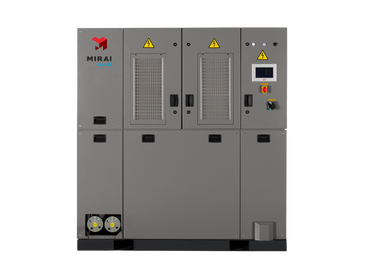
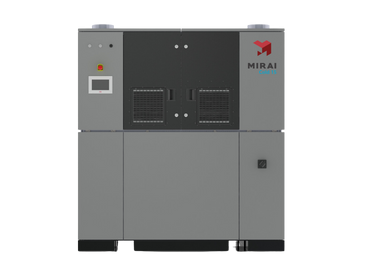
MIRAI INTEX ULT Space Cooler: A New Approach to Ultra-Low-Temperature Storage

Ultra-low-temperature refrigeration is essential for industries in which even minor temperature fluctuations can affect product quality, process stability or safety. Pharmaceutical products, biological samples, vaccines, speciality food products and industrial materials may all require reliable storage at temperatures far below the capabilities of conventional cold rooms.
However, producing and maintaining these temperatures presents several challenges. Traditional refrigeration systems often rely on synthetic refrigerants, complex cascade configurations, oil-lubricated compressors and regular defrosting procedures. As temperature requirements become more demanding, these systems can become increasingly complicated and expensive to operate.
The MIRAI INTEX ULT Space Cooler offers a fundamentally different solution. Instead of using synthetic refrigerants, it uses natural air — R729 — to provide stable cooling directly inside an ultra-low-temperature chamber.
What Is the ULT Space Cooler?
The ULT Space Cooler is a range of open-cycle air refrigeration machines designed to cool storage rooms, warehouses, cryotherapy chambers and industrial spaces.
The standard operating temperature range of the product line is from –40 °C to –130 °C.
The current ULT Space Cooler product line includes:
-
MIRAI Cold 10 O/W — a compact, water-cooled machine for laboratories, research centres and smaller storage chambers;
-
MIRAI Cold 15 O/A — an air-cooled solution that does not require an external water-cooling circuit;
-
MIRAI Cold 22 O/W — a higher-capacity, water-cooled machine for medium-sized and large ULT chambers.
.png)
Multiple machines can be installed in parallel when greater refrigeration capacity or system redundancy is required. This enables the cooling concept to be adapted to the chamber volume, heat load and reliability requirements of each project.
Air as the Refrigerant
At the core of the ULT Space Cooler is air-cycle refrigeration technology, also known as the reverse Brayton cycle with recuperation.
During operation, air is compressed, causing its pressure and temperature to increase. The compressed air is then cooled in heat exchangers and subsequently expanded in a turboexpander. Expansion produces a substantial temperature drop, after which the cold air is delivered directly into the customer’s chamber.
The air from the chamber returns to the refrigeration system, where the cycle is repeated continuously.
Because the process is based on compression and expansion rather than evaporation and condensation, it does not require the synthetic refrigerants normally used in vapour-compression and cascade refrigeration systems.
.png)
Air, classified as refrigerant R729, has:
-
zero global warming potential;
-
zero ozone depletion potential;
-
no toxicity;
-
no flammability;
-
no risk of refrigerant phase-out;
-
unlimited availability.
Air is also not subject to the restrictions imposed on fluorinated refrigerants under the EU F-gas Regulation. This makes the technology a future-proof option for companies planning refrigeration infrastructure with a long operating lifetime.
Direct Cooling Without an Evaporator in the Chamber
One of the main differences between the ULT Space Cooler and a conventional refrigeration system is the open-cycle design.
The refrigerated air is supplied directly from the turboexpander into the cold room. As a result, there is no need to install a conventional evaporator inside the chamber. The system also reduces the number of auxiliary components required in the cold zone.
Removing the evaporator from the chamber offers several practical advantages:
-
more usable storage space;
-
fewer components exposed to ultra-low temperatures;
-
reduced internal heat input;
-
easier chamber integration;
-
fewer potential maintenance points;
-
lower noise and vibration inside the cooled space.
This design is particularly beneficial for pharmaceutical storage, laboratories, automated sample-storage systems and applications involving vibration-sensitive products or equipment.
Continuous Operation Without Conventional Defrosting
Humidity is one of the most persistent challenges in ultra-low-temperature storage. Every time a chamber door is opened, moist ambient air can enter the cold space. At extremely low temperatures, this moisture freezes immediately and may accumulate on evaporators, products, walls and internal equipment.
In conventional systems, the resulting frost gradually reduces heat-transfer efficiency and restricts airflow. The refrigeration process must therefore be interrupted periodically to defrost the evaporator.
MIRAI INTEX addresses this problem with the Snow Catcher, also known as the Humidity Extraction Device.
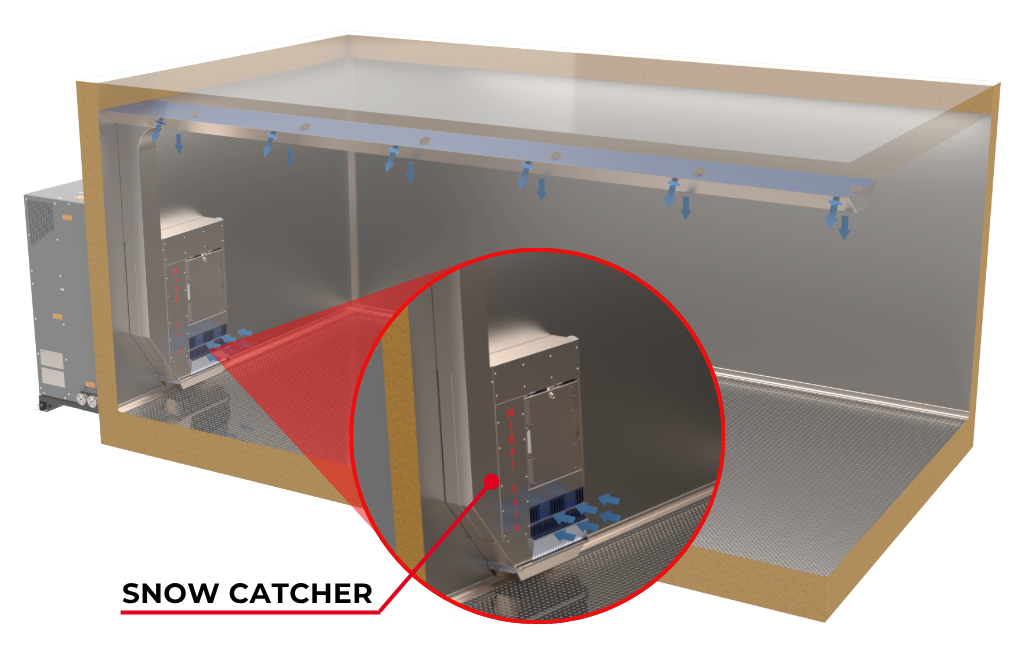
Moisture contained in the air turns into fine ice particles during the refrigeration process. The Snow Catcher captures these particles and removes them from the air circuit before they can accumulate inside the chamber. The collected snow can then be removed from the system.
This approach helps to prevent frost formation on stored products and internal equipment while eliminating conventional energy-consuming defrost cycles. The ULT Space Cooler can therefore maintain continuous refrigeration without regular thermal defrost interruptions.
Oil-Free Turbo Technology
The MIRAI turbo-module combines the compressor and turboexpander on a single shaft. Energy generated during air expansion is transferred directly to the compressor, reducing the amount of electrical energy required to operate the system.
.png)
Instead of conventional oil-lubricated bearings, the turbo-module uses gas-dynamic air bearings. Once the shaft reaches its operating speed, it rotates on a thin cushion of air without direct mechanical contact.
This design provides several important benefits:
-
no oil circulation system;
-
no risk of oil contamination;
-
no regular oil changes;
-
minimal mechanical wear;
-
reduced maintenance requirements;
-
stable performance throughout the machine’s service life;
-
lower vibration levels.
The absence of oil is particularly relevant in pharmaceutical, biotechnology and laboratory applications where cleanliness, reliability and predictable maintenance are critical.
Precise Control at Full and Partial Load
The refrigeration demand of a cold room is rarely constant. It changes depending on door openings, product loading, ambient conditions and the stage of the cooling process.
MIRAI INTEX machines use inverter-controlled synchronous motors to adjust the turbo-module speed continuously. The system can therefore adapt its refrigeration capacity to the actual heat load instead of relying solely on repeated start-stop operation.
The ULT Space Cooler maintains temperatures within the –40 °C to –130 °C operating range with control accuracy of up to ±0.5 °C under changing loads.
Efficient partial-load operation helps to:
-
maintain stable chamber temperatures;
-
reduce unnecessary power consumption;
-
avoid frequent compressor cycling;
-
lower stress on electrical infrastructure;
-
support continuous long-term storage;
-
reduce operating costs.
The integrated control system includes a touchscreen interface for setting and monitoring the required operating parameters. Digital communication protocols such as PROFINET, EtherCAT, EtherNet/IP and POWERLINK are available as standard. Data archiving, real-time monitoring and remote diagnostics can also be integrated into the system.
Applications of the ULT Space Cooler
The open-cycle technology can be adapted to a broad range of ultra-low-temperature applications. We have a lot of projects reliased with ULT Space Cooler product line.
Pharmaceutical and Vaccine Storage
Large pharmaceutical storage rooms require temperature stability, redundancy and continuous operation. Unlike individual upright freezers, a centralised cold-room solution can provide significantly greater storage capacity while simplifying access and inventory management.
At the Recipharm facility in Wasserburg, Germany, the solution consists of two independent chambers. Each chamber has a storage area of 85 m² and a volume of 185 m³, operating between –20 °C and –90 °C. Three MIRAI Cold 10 O/W machines provide N+1 redundancy for each chamber.
Automated Biological Sample Storage
The MIRAI Cold 10 O/W has also been integrated into the Azenta BioArc Ultra High Density automated sample-storage system.
Designed for storage at –80 °C, the system can accommodate up to 16.92 million 0.9 ml tubes. According to the project data, it uses up to 77% less power and requires up to 73% less floor space than conventional storage approaches, while operating with a refrigerant that has zero GWP.
Containerised and Mobile ULT Storage
ULT Space Coolers can be integrated into standard containers and semi-trailers to create mobile ultra-low-temperature storage solutions.
Containerised vaccine-storage projects have been developed with operating ranges from –40 °C to –110 °C and storage volumes of up to 110 m³. A semi-trailer solution with a storage volume of 43 m³ demonstrates how air-cycle refrigeration can help close the gap between stationary ULT storage and temperature-controlled transport.
Depending on the available infrastructure, a water-cooled MIRAI Cold 10 O/W or an air-cooled MIRAI Cold 15 O/A can be used.
Food Storage
Open-cycle machines are suitable for products such as high-quality tuna, which requires stable ultra-low storage temperatures.
The direct-air system provides the required refrigeration capacity and temperature uniformity. At the same time, the Snow Catcher removes moisture from the chamber, helping prevent ice accumulation on the product and storage equipment.
Cryogenic Steel Treatment
Cryogenic treatment can improve the mechanical properties and dimensional stability of steel components. Such processes are commonly performed at temperatures between –70 °C and –120 °C.
A system developed with Refolution uses the MIRAI Cold 22 O/W to cool a specialised treatment chamber. The solution provides stable temperature control and enables continuous operation without conventional evaporator defrosting.
Whole-Body Cryotherapy
MIRAI air-cycle technology has been used in a whole-body cryotherapy chamber in Karlsruhe, Germany, since 2019.
The MIRAI Cold 15 O/A provides temperatures down to approximately –130 °C with uniform conditions throughout the chamber. The project also demonstrates the possibility of recovering heat from the refrigeration system: warm exhaust air from machine cooling can be used to heat other areas of the wellness facility.
Lower Maintenance and Operating Costs
The total cost of an ultra-low-temperature system is determined by more than its initial purchase price. Refrigerant replacement, leak inspections, oil service, defrost energy, component wear and production interruptions can all significantly increase lifetime costs.
The ULT Space Cooler reduces many of these requirements:
-
air does not need to be purchased or refilled;
-
there are no synthetic refrigerant leak inspections;
-
the turbo-module operates without oil;
-
the Snow Catcher eliminates conventional defrosting;
-
partial-load control reduces unnecessary energy use;
-
the open-cycle design reduces the number of components inside the cold chamber;
-
long-life components help maintain stable performance over time.
The result is a refrigeration system designed not only to reach ultra-low temperatures, but also to maintain them reliably throughout many years of operation.
A Scalable and Future-Proof ULT Solution
Ultra-low-temperature refrigeration no longer needs to depend on complex cascade systems, synthetic refrigerants or regular defrost cycles.
By combining air as the refrigerant, an oil-free turbo-module, energy recuperation, precise capacity control and continuous humidity extraction, the MIRAI INTEX ULT Space Cooler provides a scalable platform for demanding storage and process applications.
Whether the project involves pharmaceutical products, biological samples, industrial materials, speciality food, cryotherapy or mobile ULT storage, the system can be configured according to the required chamber volume, temperature range, redundancy level and available utilities.
MIRAI INTEX works with customers, engineering companies and OEM partners to develop complete ultra-low-temperature solutions based on the specific requirements of each application.
Contact MIRAI INTEX to discuss how the ULT Space Cooler can be integrated into your next ultra-low-temperature project.