Industrial Lyophilizer Refrigeration for Large-Scale Freeze Drying

An industrial lyophilizer is specialized equipment that removes moisture from the substance or product using sublimation technology. It cools down the material and removes ice by turning it directly into vapor under low pressure. This technique preserves the product quality, its molecular structure, and physical traits. At MIRAI INTEX, we build the refrigeration heart of these systems: air-cycle machines that cool the shelves and the condenser.
Refrigeration is a core part of every industrial lyophilizer, because controlled product freezing and a cold condenser are what make sublimation possible. MIRAI INTEX does not build freeze dryers. We design and manufacture the air-cycle refrigeration machines that cool their shelves and condensers, either as stand-alone units or as a built-in module of OEM equipment. All of them are produced at our own facility in Brno, Czech Republic, which is certified to ISO 9001:2015. Our machines are integrated into systems from HOF Sonderanlagenbau, IMA Life and GEA, and they freeze product down to −80 °C (−112 °F) with no F-gas and no liquid nitrogen.
How the Industrial Freeze Drying Process Works
The principle of how an industrial freeze dryer lyophilizer works is embodied in three stages.
- Pre-freezing stage. The product is loaded onto temperature-controlled shelves of the chamber and is cooled below its freezing point. At that point, moisture in the product turns into solid ice crystals.
- Primary drying (sublimation) stage. At this stage, a powerful vacuum pump decreases the pressure in the chamber below the triple point of water. The product is gently heated and, instead of melting, its frozen liquid changes its structure directly into vapor. This vapor migrates to an ultra-cold condenser where it desublimates as ice on the condenser surfaces. At this stage, up to 95% of water is removed from the product.
- The third stage is secondary drying. During it, the pressure in the chamber remains low, but the temperature rises above ambient level. This helps drive away the residual water from the product and makes it shelf-stable.
Main Components of an Industrial Lyophilizer
The construction of an industrial lyophilizer machine consists of several key elements:
- The product chamber is a hermetically sealed block where the product is loaded. The drying chamber environment is controlled, sterile, and vacuum-tight.
- Temperature-controlled shelves in the product chamber are stainless steel plates with internal channels, where a heat-transfer fluid circulates for controlled and gradual heating of the product.
- The internal condenser is a refrigerated surface/coil that operates at extremely low temperatures and helps freeze and capture evaporated water in the product.
- The vacuum pump provides a low pressure inside the product chamber and helps evacuate air and non-condensable gases from it.
- The refrigeration system is the backbone of the lyophilizer. It provides a dual action: shelf freezing at the start of the sublimation cycle, and condenser cooling during primary and secondary drying.
Air-Cycle Refrigeration for Large Scale Freeze Dryers
At MIRAI INTEX, we build air-cycle refrigeration for industrial lyophilizers. Our machines compress and expand air (R729) in a closed cycle inside an oil-free turbo module running on air bearings. There is no F-gas and no liquid nitrogen (LN2) in the system, and air has a GWP of 0, which protects your investment as HFC phase-down rules tighten. The machines run efficiently at partial load from 10% to 100%, so they follow the real demand of each freezing and drying phase. With no oil and few wearing parts, maintenance is minimal. Plug & Play connection makes them a practical choice for retrofitting existing freeze dryers.
Key Features and Specifications
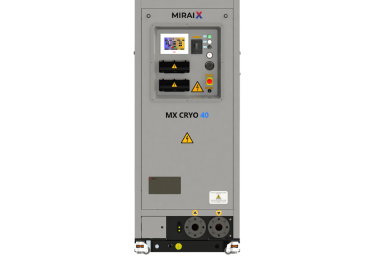
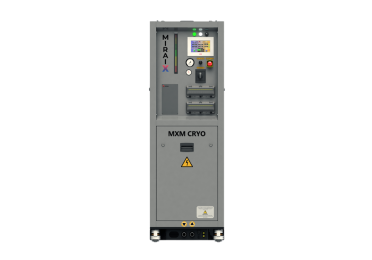
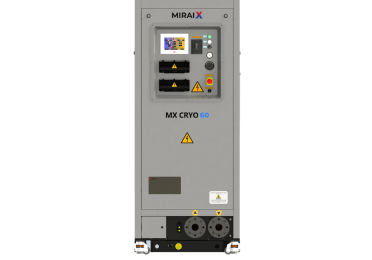
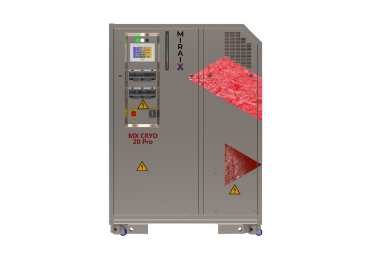
For our partners and clients utilizing industrial lyophilizers to meet GMP standards, we provide the MIRAI X CRYO product line that includes refrigeration systems designed for heating and cooling heat transfer liquids in large-scale lyophilizers. For space-limited configurations, there is also the MIRAI XM CRYO product line with the same sustainability, precise temperature control, and multifunctionality. Besides, the ULT LIQUID COOLER product line, which works on the closed-cycle principle, is also suitable when only cooling is required.
|
Feature |
MIRAI X CRYO 20 PRO |
MIRAI X CRYO 40 |
MIRAI X CRYO 60 |
MIRAI XM CRYO 20 |
|
Footprint/size (cm) |
130x94x180 |
80x177x197 |
80x177x197 |
60x160x178 |
|
Rated motor power (kW) |
20 |
40 |
60 |
20 |
|
Max heating temperature °C/°F |
+90/+194 |
+90/+194 |
+90/+194 |
+80/+176 |
|
Max freezing temperature °C/°F |
-160/-256 |
-160/-256 |
-160/-256 |
-120/-184 |
|
Nominal heating capacity (kW) |
12 |
18 |
18 |
18 |
MIRAI X CRYO 40 and 60 suit large production freeze dryers, while the compact MIRAI XM CRYO 20 fits installations where floor space is limited.
Pharma Freeze Drying Applications and Case Studies
The use of MIRAI X CRYO chillers in the pharmaceutical industry is one of the solutions addressing the transition to environmentally friendly production. In our practice, the following cases have been completed:
- At CSL Behring in Marburg, Germany, three CryoBlizzard freeze dryers built by HOF Sonderanlagenbau were retrofitted with our refrigeration in 2023. Each dryer has 20 m² of shelf area and freezes product down to −80 °C, with no F-gas in the system.
- IMA Life uses MIRAI INTEX air-cycle technology in its KryoAir refrigeration, developed together with ACT. KryoAir is offered in IMA Life’s range of industrial lyophilizers for sale.
- Among the industrial lyophilizer manufacturers, GEA uses our air-cycle technology in its GEA LYOAIR system, which reaches down to −60 °C (−76 °F) on the shelves and −90 °C (−130 °F) on the condenser.
What to Consider When Buying an Industrial Lyophilizer
When you invest in an industrial lyophilizer for your facility, you need to ensure that its characteristics will suit your goals and the equipment will work reliably for many years. The core features to evaluate are as follows:
- Capacity and throughput are the starting points for your choice. It is feasible to evaluate the shelf area and its compatibility with your product packaging (batches, trays, bottles, etc.). Besides, condenser capacity and speed are important. Its ice capacity must cover the total moisture load of a full batch.
- The next thing to check is GMP requirements compliance. The industrial lyophilizer’s parts should be made of AISI 316L stainless steel, it should have CIP and SIP systems for cleansing and sterilization, and a through-the-wall design is common for cleanroom installation.
- Do not forget about 21 CFR Part 11/GAMP 5 validation, and ensure that the equipment passes the leak rate test.
- Energy and sustainability are important because they save your costs and help your manufacturing facilities meet environmental requirements. Our air-cycle machines use no F-gas and no LN2, which supports these sustainability targets.
One more thing to consider is readiness for retrofit. When you buy an industrial lyophilizer, it is a long-lasting investment, and with time you may need to modernize it. So you need an engineering solution that you can further scale up, retrofit, or rebuild.
Industrial Lyophilizer Price and Total Cost of Ownership
When you decide to purchase an industrial lyophilizer, please keep in mind that capital expenses are only a part of the overall industrial lyophilizer price. Total cost of ownership also includes validation costs, energy consumption costs, infrastructure development costs, and further servicing.
For the refrigeration part, cost depends on the required cooling and heating capacity, the lowest shelf and condenser temperatures, whether it is a new project or a retrofit, and the validation scope. Lower energy use, no LN2 purchases and minimal maintenance reduce operating costs over the life of the dryer. Send us your process data, and we will prepare an individual calculation.
FAQ
What is an industrial lyophilizer used for?
Industrial lyophilizers are freeze dryers that remove moisture using sublimation technology, preserving the molecular structure, potency, and physical traits of sensitive materials and substances.
What should be considered when buying an industrial lyophilizer?
The first and foremost thing to consider when you need to buy an industrial lyophilizer is the compliance of its technical parameters with the industry it will be used in, and the specifics of the product you will sublimate with its help. Besides, such factors as energy efficiency, reliability and quality of its components are decisive.
What are the applications of industrial lyophilizers in different industries?
Their operation predetermines their scope of application: they are necessary for heat-sensitive live-attenuated or viral-vector vaccines, antibodies, and sterile drug preservation; they help retain the biological activity of enzymes and blood products during storage; they are used for food storage as an alternative to thermal dehydration (including fresh fruits and vegetables, instant coffees and soups, snacks, and confectionery products); besides, they help preserve microbial and bacterial strains for research and biotechnology goals.
CTA: We invite you to become an OEM partner of MIRAI INTEX. Please contact our sales managers to request a quote for an industrial lyophilizer cooling system.